

Optimizing crisis communication to keep users on board
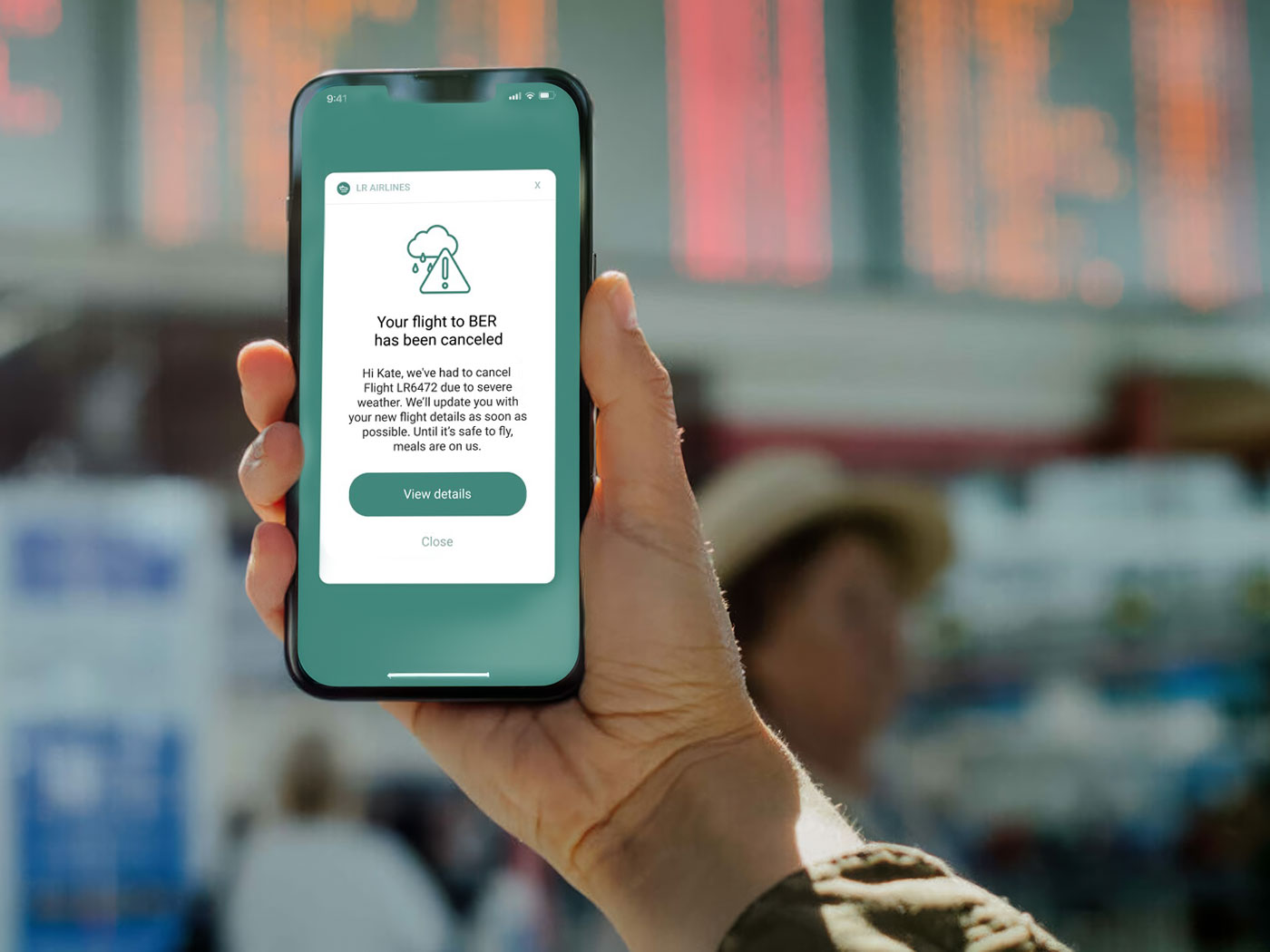
I drafted a cancellation message showing how airlines can improve the user experience during crises by shifting from an informative tone (“Attentive Concierge”) to a reassuring one (“Proactive Guardian”).
Time frame: March 2023
Tools: Figma
Why I’ve included this project in my portfolio
This project demonstrates my ability to:
- Anticipate how subtle differences in tone can influence user engagement and brand perception.
- Understand user needs and adapt content and tone to different contexts.
- Integrate research insights into UX writing strategies.
Overview
On Day 1 of a 14-day UX writing challenge  , the following prompt landed in my email inbox:
Scenario: A traveler is in an airport waiting for the last leg of a flight home when their flight gets abruptly canceled due to bad weather.
Challenge: Write a message from the airline app notifying them of the cancellation and what they need to do next.
Headline: 45 characters max
Body: 175 characters max
Button(s): 25 characters max
As it happened, I’d been mulling over this very scenario for some time already, because a few weeks ago, my flight was canceled, and I was that traveler.
And as I’d waited in line at the customer service desk, I’d had plenty of time to ponder what the experience was – frustrating, annoying, full of lines – and what it wasn’t – supportive, empathetic, efficient.
So, when I saw an opportunity to improve the user experience for fellow travelers, I was ready. I was invested.
Goals
1. Develop a writing strategy to address user needs and achieve stakeholder goals.
2. Compose a cancellation message based on this strategy.

PLAN
Goal: Outline general project goals that align with the stakeholder’s longer-term business objectives.
I began by considering a theoretical request from a stakeholder that could set the writing process in motion.
Stakeholder request:
“As soon as we announce a flight cancellation, we get a barrage of calls from angry passengers demanding answers that we don’t have yet. We need a new cancellation message that will keep passengers’ frustrations from escalating while we find out how the cancellation will impact our operations.”
Next, I defined what an effective cancellation message would accomplish for the stakeholder. To maximize the overall value of the project, I made sure that the short-term goals for the message aligned with the stakeholder’s broader strategic interests.
Stakeholder goals
EMPATHIZE
Goal: Consider how the situation affects users and their emotions.
I considered how passengers would feel before and after learning about the flight cancellation. This would help me to craft a message that resonated with users’ current emotional state.
User emotions
RESEARCH
Goal: Gain greater insight into user experiences.
This exercise was designed to be brief, which limited the scope of my user research. For insight into user perspectives, I supplemented my own anecdotal experiences with research findings from a 2019 research study titled “Worry and anger from flight delay: Antecedents and consequences”.
Article insights:
After surveying more than 600 passengers, researchers discovered patterns in how passengers felt, thought and acted when facing flight disruptions:
- When passengers attributed the disruption to human error, they felt angry.
- When passengers weren’t sure how long the disruption would last, they felt worried.
- If passengers felt angry or worried, they were more likely to act in ways that could damage the airline’s interests, for example by spreading negative word-of-mouth or switching to other airlines for future travel.
ANALYZE
Goal: Use findings from user research to identify needs and pain points.
Based on my own personal experience and the study’s findings, I concluded that:
- Passenger needs fell into 2 general categories: logistical or emotional.
- To be effective, the cancellation message would need to address the logistical and emotional needs likely to emerge when flights were disrupted.
I mined the study’s findings for further insight. In the table below, I’ve shown how I interpreted the thoughts and feelings reported in the study as indicators of specific unmet needs.
User needs during flight disruptions: insights from user research
Next, I created a list of user pain points to highlight key issues that could hinder the cancellation message from meeting user needs.
User pain points
STRATEGIZE
Goal: Develop a basic plan for responding to user needs when flights are disrupted.
To kick off the strategy phase, I envisioned a positive end result: a “goal scenario” in which key passenger needs were satisfied despite the flight disruption.
After exploring the thoughts and feelings that users might experience in this scenario, I worked backward to develop a strategy for achieving that desired outcome, as shown in the table below.
Messaging strategy for a positive user experience
DEVELOP VOICE AND TONE GUIDELINES
Goal: Establish a brand voice and clarify how the tone of voice can be modified to suit different situations.
The UX challenge instructions hadn’t specified a brand voice for the airline, so I created a basic set of voice guidelines to serve as a reference during the writing stage.
To establish the brand voice, I first identified 3 key attributes that captured the essence of the airline’s “personality.” Then I specified the specific communication practices that should be adopted or avoided to maintain the desired voice.
Voice guidelines
I crafted guidelines for adapting the vocabulary, verbosity and other messaging elements to 2 specific contexts:
- A “routine flight situation,” in which the flight proceeded as planned.
- A “disrupted flight situation,” in which delays or cancellations affected the flight’s normal operations.
To clarify the distinction and make the guidelines easier to implement, I identified an archetype that represented the desired tone in each situation.
Tone guidelines
WRITE
Goal: Draft a cancellation message that aligns with the strategy, voice and tone outlined above.
I created 3 drafts of the cancellation message and evaluated each one based on how well it met my goals for the text.
The table below shows the text from all 3 drafts.
Cancellation message drafts
Below, I explain my decisions to “keep,” “modify,” or “discard” specific elements of each draft. For any elements marked “Keep, pending user tests,” I’ve noted what I would focus on during user testing.
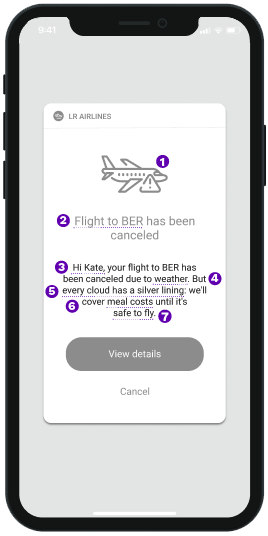
Draft 1
 The warning sign over the airplane can create unnecessary alarm by causing passengers to worry about flight safety.
Verdict: Discard
 “Flight to BER” might confuse passengers on multi-leg journeys, since it doesn’t specify which flight is affected.
Verdict: Discard
 Using the passenger’s name adds a personal touch, makes the message feel warmer, and grabs attention right away.
Verdict: Keep
 “Weather” is vague and could leave passengers wondering if the situation is serious enough to warrant a cancellation.
Verdict: Modify
 The wordplay is idiomatic, which could confuse passengers. It could also suggest that the airline isn’t taking the situation seriously and lacks empathy about the inconvenience passengers are experiencing.
Verdict: Discard
 “Meal costs” feels formal and distant, which may make it seem like the airline lacks empathy for passengers.
Verdict: Modify
 “Until it’s safe to fly” is implicitly reassuring, since it indicates that takeoff will occur only under safe circumstances.
Verdict: Keep
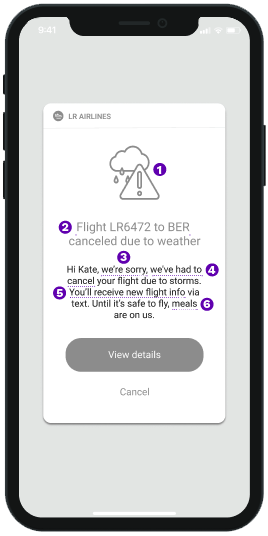
Draft 2 A weather-related icon clearly communicates the reason for the cancellation without raising unnecessary alarm.
Verdict: Keep
Including specific flight details, like the flight number, can boost users’ confidence in the message’s legitimacy, which is especially important given recent scams involving fake airline cancellations. But these details should be included in the message body to declutter the headline.
Verdict: Modify
An apology feels hollow here, since the cause – weather – is outside the airline’s control. Clearly stating that external factors are to blame can reduce passenger frustration by showing that the cancellation isn’t due to human error.
Verdict: Discard
Switching from passive to active voice reassures passengers that the airline is proactive and confident in its decision-making.
Verdict: Keep
Less passive phrasing would communicate that the airline is in control of the situation.
Verdict: Modify
“Meals” sounds more conversational than “meal costs” and downplays the focus on money. This can boost user trust in the airline’s sincerity and empathy.
Verdict: Keep
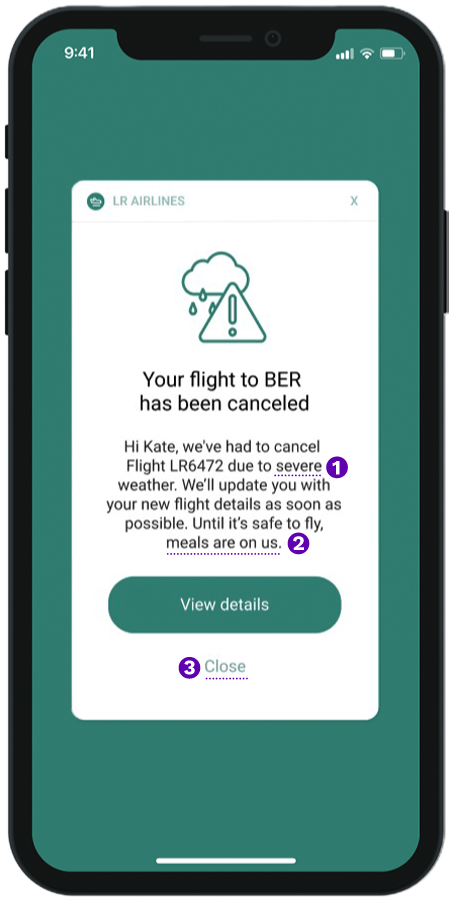
Draft 3 (Final draft)
Adding “severe” helps make it clear the airline didn’t take the cancellation lightly.
Verdict: Keep
“Meals are on us” is idiomatic, which conveys a warm tone but may be confusing, especially to non-native English speakers. User testing would indicate whether the phrasing needs to be revised for clarity.
Verdict: Keep, pending user tests
Replacing “Cancel” with “Close” reduces confusion by indicating that users will still have access to the message after closing the window.
Verdict: Keep
TEST
Goal: Evaluate how users respond to the finalized message draft.
Although I didn’t carry out user testing for the purposes of this exercise, in a hypothetical next phase, I would employ techniques such as user interviews, A/B testing and surveys to collect user feedback on the final draft.
User feedback would help identify whether idiomatic phrases (like “we’ll cover meals”) were confusing. It could also suggest other ways to enhance user experience, such as an in-app “how-to guide” for navigating flight disruptions.
Monitoring KPIs would indicate progress toward the goals established during the planning phase.
Takeaways
1. A balance of sources would give greater insight into user needs.
Drawing on desk research for insight was time-efficient, but it also presented certain limitations. For example, the circumstances investigated in the 2019 research study (flight delays) differed from those I explored here (flight cancellations).
In a full-scale project, it would be useful to gather insight into user needs from a variety of sources, such as passenger interviews, online reviews and interviews with customer support staff who handle passenger complaints.
2. Aligning the interests of stakeholders and users points to common ground on contentious issues.
There’s often an “us-versus-them” dynamic between passengers and the airline industry. I enjoyed the opportunity to move beyond this adversarial dynamic in this exercise and explore how consumer-friendly strategies support, rather than threaten, airlines’ business interests.